Before I set a quit date, I’d make sure cash - not expected pay - can cover my bills and exit costs. For example, a $3,000 monthly income gap needs $9,000 for three months, before equipment costs or other exit bills.
Here’s what I’d check:
- My budget: Separate household bills from trucking costs and calculate the take-home pay I need.
- My exit fund: Cover insurance, training, contract fees, and unpaid bills while keeping emergency savings separate.
- My equipment: Get written payoff amounts and estimate sale proceeds after debt, repairs, and fees.
- My next income: Compare staying on the road while preparing with leaving now. Verify pay and start dates, and protect driving and rest time.
- My quit date: Check how long my savings will last and fund a fallback before giving notice.
<u>I wouldn’t count my final settlement as available cash.</u> The article notes that contractors may wait 15–90 days, and deductions can shrink the payment. If health or safety requires an earlier exit, I’d plan around that limit - not assume I can keep driving.
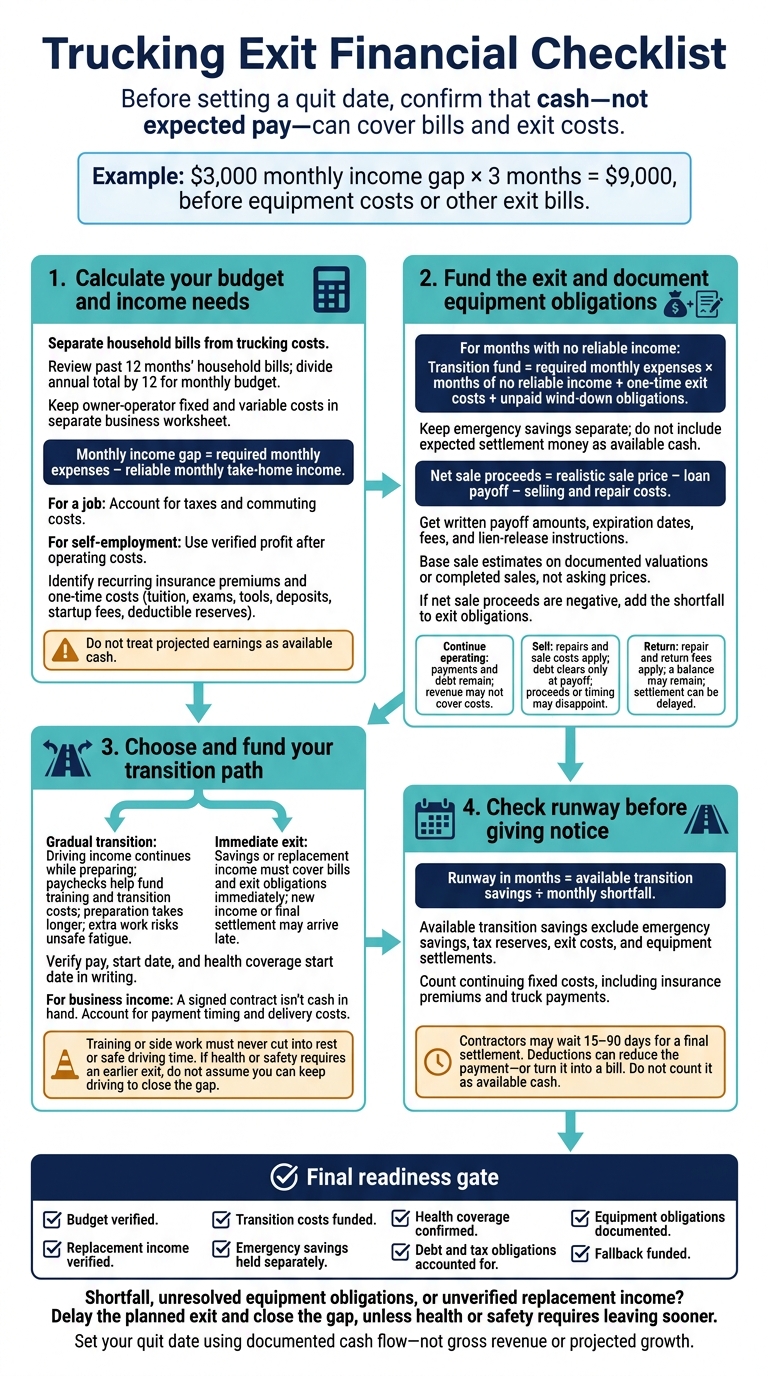
Trucking Exit Financial Checklist
1. Calculate Your Budget and Income Needs
Separate Household Bills From Road Costs
Add up your housing, utilities, groceries, minimum debt payments, required insurance, and family bills from the past 12 months. Divide annual bills by 12 to budget for them each month.
Adjust grocery and personal transportation costs to reflect life at home. Keep owner-operator expenses in a separate business worksheet, with fixed and variable costs tracked separately. Only mark a cost as ending when the obligation ends - not when you stop driving.
Then compare your household expenses with the income you can count on.
Calculate Your Required Take-Home Income
Monthly income gap = required monthly expenses − reliable monthly take-home income.
For a job, use pay after taxes and commuting costs. For self-employment, use verified profit after operating costs. Either way, leave projected earnings out of the calculation until the cash is in hand.
Once you know the gap, account for costs you'll face before your first paycheck or business launch.
Add Insurance, Training, and Startup Costs
Separate recurring expenses from one-time costs and transition costs due upfront. Include insurance premiums in your monthly budget, and set aside money for deductibles. Check the prices of tuition, exams, tools, deposits, and startup fees before committing.
Use these totals alongside your savings and equipment obligations to calculate how much you need to save before leaving the road safely.
sbb-itb-f24084b
2. Fund Your Exit and Settle Equipment Obligations
Calculate Transition Funds and Emergency Savings
Use your monthly gap to work out how much cash you need before leaving. Before you set a quit date, make sure you can pay for the transition without dipping into emergency savings.
Transition fund = required monthly expenses × months of no reliable income + one-time exit costs + unpaid wind-down obligations. Do not count settlement money as cash you can use.
Compare your cash on hand with that total, keeping emergency savings separate.
Verify Equipment Payoffs and Sale Proceeds
Create a wind-down worksheet for truck and trailer loans or leases, liens, fees, taxes, maintenance bills, and insurance costs. Ask for written payoff amounts that include expiration dates, fees, and lien-release instructions. Check early-termination terms and confirm what insurance coverage applies after termination.
Net sale proceeds = realistic sale price − loan payoff − selling and repair costs. Base the price on documented valuations or completed sales - not an asking price. If the result is negative, budget enough to cover the shortfall and clear the lien. Don’t assume escrow will cover it. Repairs and other deductions can turn the settlement check you expected into a bill.
Add any shortfall to your exit obligations. Then check whether your savings can cover the total by your planned quit date.
Compare Ways to Handle Your Equipment
| Option | Cash required | Remaining debt | Timing | Financial risk |
|---|---|---|---|---|
| Continue operating | Payments must continue | Debt remains | Monthly | Revenue may not cover costs |
| Sell equipment | Repairs and sale costs | Debt cleared only at payoff | Depends on buyer | Lower proceeds or delays |
| Return equipment | Repair and return fees | Balance may remain | Settlement delayed | Debt can survive the return |
If you return equipment, get the authorized drop-off location in writing, photograph the truck inside and out, and attend the inspection.
Next, compare a gradual transition with a full exit.
3. Compare a Gradual Transition With an Immediate Exit
Once you know your cash gap and exit costs, decide whether to transition gradually or leave immediately. Training or side work should never cut into rest or safe driving time. Here’s how the two paths compare.
| Factor | Gradual transition | Immediate exit |
|---|---|---|
| Income | Driving income continues while you prepare. | Savings or replacement income must cover bills. |
| Cash needed | Paychecks help pay for training and transition costs. | Cash must cover the income gap and exit obligations. |
| Timing | Preparation takes longer because it must fit around driving and rest. | You need cash to cover the full gap right away. |
| Main risk | Extra work can lead to unsafe fatigue. | New income or your final settlement may arrive late. |
Verify New Income While You Keep Driving
Get your pay, start date, and coverage start date in writing. Compare your verified take-home pay with the monthly income you need. Fit training within legal work hours and rest limits.
If you’re starting a business, test demand through paid work during off-duty hours and keep receipts. Use a separate profit-and-loss statement to track net income after expenses and taxes. A signed contract isn’t cash in hand. Treat it as expected income, accounting for payment timing and the cost of delivering the work.
Fund Your Plan Before an Immediate Exit
Before you stop driving, confirm that cash or replacement income can cover your bills until payments begin. Write down your debt, equipment, and tax obligations, along with payment due dates. Contractors may wait 15–90 days for a final settlement, so account for that delay in your payment schedule.
If health or safety means you need to leave sooner, don’t assume you can keep driving to close the gap. Use your remaining cash gap and payment timing to set your quit date in the next checklist.
4. Use a Financial Checklist to Set Your Quit Date
Check How Long Your Savings Will Last
Use the numbers above to check whether your savings will cover you until your next paycheck or business launch.
Runway in months = available transition savings ÷ monthly shortfall. Keep emergency savings, tax reserves, exit costs, and equipment settlements out of your runway calculation.
Count fixed costs that continue even when your truck is parked, including insurance premiums and truck payments. If your final settlement is delayed, budget for a 15- to 90-day wait for your last check.
Complete Your Checklist Before Giving Notice
A gradual transition needs enough runway to cover delays. An immediate exit requires every cost to be funded up front.
If your runway checks out on paper, review this checklist before giving notice:
- [ ] Budget verified.
- [ ] Replacement income verified.
- [ ] Transition costs funded.
- [ ] Emergency savings held separately.
- [ ] Health coverage confirmed.
- [ ] Debt and tax obligations accounted for.
- [ ] Equipment obligations documented.
- [ ] Fallback funded.
Delay your exit if your worksheet shows a shortfall, equipment obligations are unresolved, or replacement income isn't verified. Finish the worksheet and close the cash gap. Set your quit date using documented cash flow - not gross revenue or projected growth - and only after every checklist item is complete.
FAQs
How much extra savings should I budget for job delays?
Aim to set aside enough cash to cover at least two to three months of basic expenses. Contract termination periods can run from 15 to 90 days before final settlements are processed, so budget for that gap in income.
Add up your monthly fixed costs - truck payments, insurance, and family bills - and multiply the total by three. That buffer helps pay for downtime, delayed payments, and the costs of moving to a new job.
What if my truck is worth less than I owe?
You have negative equity, often called being underwater. Leaving trucking doesn’t cancel your loan or lease obligations. If you can’t pay the gap between the sale price and your loan balance, expect a bill.
Contact your carrier or lender right away to discuss charges and a possible settlement. Unpaid debt can damage your credit and make it harder to borrow. Before agreeing to a settlement, check every debit and credit in your closing documents.
How can I afford to leave if driving becomes unsafe?
If driving becomes unsafe, don’t quit on impulse. Check your contract and contact your dispatcher or driver services right away to arrange your last day and return your equipment. Give two weeks’ notice when possible, and leave in good standing to avoid maintenance or damage charges that could hurt your credit.
Keep cash reserves for slow periods, repairs, insurance, and deductibles. Plan your budget around possible delays before your final settlement clears.
