If trucking is hurting your health, your pay, or your home life for months at a time, it may be time to plan your exit. This article boils it down to 7 clear signs: worse health, burnout, unsafe driving, strain at home, low job satisfaction, unstable income, and a steady pull toward another line of work.
Here’s the short version: one bad month is one thing. But if the same problems keep coming back even after time off, route changes, or switching companies, that’s a different problem. And for owner-operators, one repair bill of $20,000 to $30,000 can wipe out a year’s margin fast.
What I’d look for first:
- Health problems that don’t ease up
- Fatigue that turns into burnout
- Driving that feels less safe than it used to
- Family strain that doesn’t get better at home
- Low morale that lasts for years
- Income that only works when the truck never stops
- A clear desire to do something else
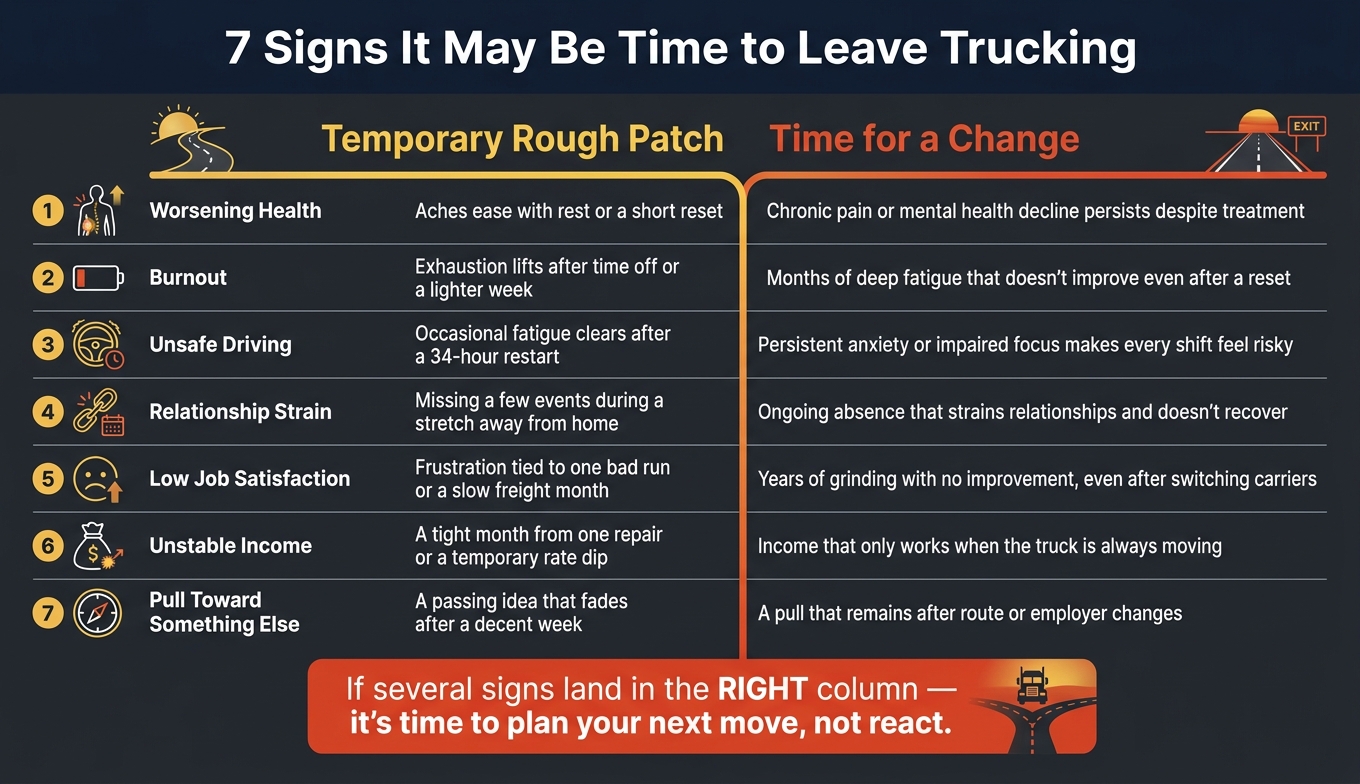
7 Signs It May Be Time to Leave Trucking: Rough Patch vs. Time to Go
Quick Comparison
| Sign | Short rough patch | Time to leave may be near |
|---|---|---|
| Health | Aches improve with rest | Pain, stress, or fatigue keep getting worse |
| Burnout | Time off helps | Rest no longer fixes it |
| Driving | One bad week | You feel unsafe most shifts |
| Family | A few missed events | Home life keeps taking hits |
| Job satisfaction | Frustration with one carrier or load | You’ve felt done for a long time |
| Income | One tight month | Bills don’t work without constant miles |
| Another career | Passing thought | The idea keeps coming back |
If several of these fit your life right now, the next move isn’t panic. It’s to track the pattern, check the numbers, and map out what comes next.
How to Tell a Rough Patch From a Real Sign It Is Time to Move On
One bad month, one hard dispatcher, or one expensive breakdown doesn't mean trucking is over for you. Freight moves in cycles, and a dip in rates or a rough repair bill can simply be part of the work.
What matters is whether the problem is occasional, recurring, or persistent. That's the line between a rough stretch and something deeper. A short-term issue, like one breakdown or a brief rate slump, is very different from a problem that keeps showing up no matter what you change. If the same issues keep hitting your safety, your family life, or your take-home pay, it's time to start thinking about a transition.
Here's a simple way to look at it: Does the problem get better after a change? If it does, you're likely dealing with something temporary. If it doesn't, that's a different story. That pattern runs through the seven signs below.
Use the table below to sort out a rough patch from a lasting problem:
| Factor | Rough Patch | Sign It May Be Time to Move On |
|---|---|---|
| Duration | Weeks to a few months | Months or years with no real improvement |
| Cause | Specific dispatcher, market dip, one breakdown | Repeating regardless of employer or route |
| Recovery | Improves after time off or a job change | Persists even after resets and changes |
| Impact on safety | Occasional stress, manageable | Consistently affecting focus or judgment while driving |
| Impact on family | Temporary strain during a hard stretch | Ongoing disconnection that does not recover at home |
| Financial | Tight month, but savings absorb the hit | No margin - one repair wipes out all profit |
This gives you a plain way to judge whether you're dealing with a temporary hit or a sign that it's time to plan a change. With that in mind, start with the clearest warning sign: health that keeps getting worse.
1. Your Physical or Mental Health Keeps Getting Worse
Poor sleep and stress are part of trucking. Pain that keeps building, anxiety that won't let up, or fatigue that follows you day after day is something else.
Duration of the Problem
If numbness, stiffness, swelling, or neck pain has been hanging around for weeks or months, that's a sign of cumulative injury, not just a normal strain. Strains and sprains make up about 50% of common truck driver injuries.
Impact on Safety or Health
Chronic pain and mental strain don't stay in the cab. They spill into how you drive. Memory lapses, poor concentration, dizziness, or anxiety behind the wheel are all safety risks. If limited range of motion is making it harder to climb into the cab, finish your pre-trip inspection, or secure cargo, a different lane, load, or route probably won't solve it.
And if your physical condition is putting your CDL at risk, that's not a small warning sign. That's a big one.
Response to Time Off or Job Changes
One of the clearest tests is simple: does rest help? If you take time off and come back still exhausted, still hurting, or still mentally drained, you're likely dealing with more than basic fatigue.
Effect on Family or Finances
Health problems don't hit only the driver. They hit the whole household. Missed home time because of injury or illness, unpaid days off the road, and the strain of dealing with a chronic condition can pile up fast.
With OTR work, pay is usually mileage-based. So when the truck stops, the income often stops too, even while fixed costs like insurance and equipment keep rolling in. If one health setback could drain your savings or keep your truck from earning, the issue isn't short-term. It's built into the setup.
If the issue isn't just pain, but exhaustion that never seems to go away, the next sign is burnout.
2. Ordinary Fatigue Has Turned Into Burnout
Feeling worn out after a long run is normal. Burnout is different. Rest stops working. You take time off, but you don't come back reset. The job keeps draining more than it gives back. At that point, this isn't just about being tired anymore. It may mean the career no longer fits.
Duration of the Problem
Regular tiredness usually fades after a break. Burnout sticks around. It builds slowly over months, sometimes years, until the job starts to feel like a fight you can't win. One driver who left trucking after 11 years said it this way:
"Truck drivers have been self-isolating for years... try and do it while life around you is crumbling, and you're left to your own thoughts, 17 hours a day."
That hits hard because it points to something deeper than lack of sleep. If you spend your full 48 hours at home dreading the next load instead of getting your head back on straight, that's a strong sign fatigue has crossed into burnout.
Impact on Safety or Health
Burnout doesn't stay in your head. It can show up as anxiety, sleep problems, slower reaction time, and stress that makes poor choices seem okay. That's not just feeling off. It's a safety issue.
Response to Time Off or Job Changes
A tired driver might bounce back with a better route or a move to a different carrier. A burned-out driver usually won't. If the root problem is the lifestyle itself - being alone for long stretches and spending too much time away from home - a new dispatcher or route won't solve it.
And when burnout starts changing your judgment or the way you drive, the risk gets a lot more serious.
Effect on Family or Finances
Burnout gets worse when home time never feels long enough and every mile still has to cover the bills.
3. Driving Now Feels Unsafe or Unmanageable
Everyone has a bad day. That's part of the job. But a pattern of unsafe driving is different. When driving starts to feel not just stressful, but flat-out dangerous, it's time to pay attention.
Duration of the Problem
A rough week can happen. Even a rough month isn't unheard of. But if you've been dragging yourself through every shift for months, that's not just a slump. If every run feels like a fight for that long, something deeper is going on. And once that pressure starts changing how you drive, the warning gets hard to ignore.
Impact on Safety or Health
Pay close attention to what happens behind the wheel. Slower reaction time, missed hazards, anxiety while driving, or feeling overloaded by conditions you used to handle with no problem all matter. When mistakes start feeling more likely, the job has crossed a line. At that point, it isn't just hard. It may not be safe anymore.
Response to Time Off or Job Changes
Sometimes a few days off helps. Sometimes a different carrier or a new route takes some pressure off. But if none of that changes how close to the edge you feel, the issue is bigger than one employer or one setup. This isn't just about being tired. It's about a job pushing you past your safe limit. And when both safety and stress start slipping, that strain usually doesn't stay in the cab.
Effect on Family or Finances
Money pressure can twist safety decisions fast. Low freight rates can push drivers into survival mode, where sitting for rest feels like something they just can't afford. That can make bad calls seem normal. If you're driving when you should be resting because the bills won't wait, the job is no longer manageable.
4. Your Home Life and Relationships Are Consistently Suffering
That pressure doesn’t stop when you park the truck. Long-haul work doesn’t just take hours out of your week. It pulls you away from the small, everyday moments that keep a family close.
Duration of the Problem
Even with a decent schedule, many long-haul drivers get only 48 hours at home each week - if they’re lucky.
"You're watching kids grow up through a phone camera, and when you're over 1000km from home and your partner is having issues, there is next to nothing you can do to help." - Adam Craig, former truck driver
If that’s your normal, this isn’t about missing one birthday or one school event. It’s a pattern, and patterns like that wear people down.
Impact on Safety or Health
Stress at home has a way of riding along with you. If your head is stuck on problems back home, your focus slips. And when focus slips, so does your ability to notice what’s happening around you on the road.
Response to Time Off or Job Changes
A new carrier or a different route can help when scheduling is the main issue. Sometimes that change is enough.
But if you’ve already switched companies or changed runs and still feel cut off from your family, that says a lot. If the schedule keeps making you unavailable when your family needs you most, the issue may not be the route. It may be the job itself.
Effect on Family or Finances
Money can make this hit even harder. If your pay only works when the wheels are turning, heading home early for a family crisis can feel out of reach. That puts you in a brutal spot: earn what you need or be where you’re needed.
When your income depends on staying out, family emergencies stop feeling like rare events. They start feeling like a constant tug-of-war.
When strain at home becomes part of the routine, the next thing to look at is simple: does this work still fit your life?
sbb-itb-f24084b
5. Your Job Satisfaction Has Stayed Low for Too Long
A rough week doesn't always mean it's time to quit. But if you've felt drained, checked out, or flat-out unhappy for years, that's a different story. A hard stretch can pass. A bad fit usually doesn't.
Truck driver job satisfaction ranks in the bottom 10% of all careers, and about 40% of truckers are actively looking for work outside the industry. That kind of unhappiness usually isn't about one bad load or one lousy week. It stacks up over time.
Duration of the Problem
If the job has felt wrong for a long time, not just after a hard run or a stressful stretch, that's a sign worth taking seriously. Too much windshield time can slowly turn into isolation, and that can wear on you more than people realize.
Impact on Safety or Health
Low job satisfaction doesn't just stay in your head. It often shows up in your body too. Stress, poor sleep, and chronic pain can all be part of the picture.
Response to Time Off or Job Changes
This is one of the clearest ways to judge what's going on. If you switch companies, change lanes, or take time off and still feel the same when you come back, the issue may be the work itself, not just one carrier or one setup.
Effect on Family or Finances
Low morale can push you toward cheaper freight just to keep moving, and that eats into your margins. At that point, the job isn't just wearing you down. It may be hitting your home life and your income too.
If dissatisfaction has started affecting your paycheck, the next sign is income that no longer feels stable enough to build on.
6. Your Income Is Too Unstable for the Life You Need
Duration of the Problem
Rates always move. That's part of trucking. But when the math stays bad month after month, you're not dealing with a rough stretch anymore.
In Q3 2024, dry van spot rates averaged about $2.01 per mile, well below contract rates of around $2.40. And in August 2024 alone, 10,770 trucking carriers exited the industry due to failures or closures, while only 6,642 entered. That kind of gap points to a long squeeze, not a short dip.
Impact on Safety or Health
When cash gets tight, drivers tend to push harder just to stay afloat. That usually means more hours, less rest, and more strain day after day. Financial pressure doesn't stay on paper for long. It starts showing up in your body too.
A major repair can make things even worse. An engine rebuild costing between $20,000 and $30,000 can wipe out an owner-operator who has no reserve. At that point, a single repair isn't just a setback. It can wreck the whole budget.
Response to Time Off or Job Changes
A short slump is one thing if you've got savings in place. A long-term problem looks different. It shows up when you can't afford to park the truck, even for a few days.
If rent and family bills are still due during a down cycle, the work stops feeling like a choice. It starts feeling like a trap.
Effect on Family or Finances
If the paycheck can't cover rent, bills, and downtime, then the job isn't supporting the life it asks you to live.
And when the numbers stop working, it's worth looking at what that means. Not just for your business, but for your home life too. Sometimes the bigger issue isn't a bad month. It's that something else may already be pulling you in a different direction.
7. You Have a Clear Pull Toward Another Career or Business
When the job no longer feels like a long-term match, the next step is pretty simple: figure out whether you're just worn out from trucking or whether you're being pulled toward a different kind of work.
Duration of the Problem
A passing thought usually disappears after a decent week on the road. A deeper pull sticks around.
If you've been thinking about another line of work for months or even years - especially one with a more predictable schedule - that deserves your attention. When the same idea keeps coming back, even during calmer stretches at work, it may be more than a rough patch.
Lida Zurabashvili, a former driver and freight broker, put it this way:
"I love trucking but the lifestyle was so hard. No routine, no normal life, not many healthy food options. My legs would get swollen. I kept thinking that this cannot be forever." - Lida Zurabashvili, Former Driver and Freight Broker
That "this cannot be forever" feeling says a lot. If it keeps showing up no matter which company you drive for, the lifestyle itself may no longer work for you.
Impact on Safety or Health
Things get riskier when more of your mental energy goes into planning your way out than staying locked in on the road.
Response to Time Off or Job Changes
This is one of the clearest ways to test what's going on. If you switch companies or routes and still feel pulled toward something else, the problem is likely the lifestyle rather than the employer. Even with better routes or a better carrier, that feeling doesn't go away - and that difference matters.
Effect on Family or Finances
If that pull keeps getting stronger, start building your next move before you walk away. Compare trucking with the work or business you're thinking about while you still have time to think clearly. That can help you avoid leaving under pressure and making a rushed choice.
Quick Self-Check: Temporary Rough Patch or Time for a Change?
Not every hard stretch means it's time to walk away. But this quick check can help you see whether you're dealing with a short-term slump or the same problems on repeat.
| Sign | Temporary Rough Patch | Time for a Change |
|---|---|---|
| 1. Worsening Health | Aches that ease with rest or a short reset | Chronic pain, strains, or mental health decline that persists despite treatment |
| 2. Burnout | Exhaustion that lifts after time off or a lighter week | Months of deep fatigue that doesn't improve even after a reset |
| 3. Unsafe Driving | Occasional fatigue that clears after a 34-hour restart | Persistent anxiety or impaired focus that makes every shift feel risky |
| 4. Relationship Strain | Missing a few events during a stretch away from home | Ongoing absence that strains relationships |
| 5. Low Job Satisfaction | Frustration tied to one bad run or a slow freight month | Years of grinding with no improvement, even after switching carriers |
| 6. Unstable Income | A tight month from one repair or a temporary rate dip | Income that only works when the truck is moving |
| 7. Pull Toward Something Else | A passing idea that fades quickly | A pull that remains after route or employer changes |
The big thing to watch across all seven signs is simple: have reasonable fixes already failed? Maybe you've switched companies, changed routes, taken time off, or tried to reset your schedule. If you gave those options a fair shot and the same issue is still sitting there, that's a strong sign.
And if several rows land in the right column, that's not just a bad week. It usually means it's time to start mapping out your next move.
What to Do Next if Several Signs Apply to You
If several signs above point to a long-term problem, the most useful move right now is to stop guessing and start writing things down. Keep a simple log for at least 30 days. Track repeat health problems, missed family events, dispatch pressure that pushed you into unsafe hours or driving tired, and your weekly cash flow. A written pattern is a lot harder to brush off than a gut feeling. If the same issues keep showing up week after week, it’s time to move from observation to numbers.
Then pull your financial records: settlement sheets, bank statements, maintenance records, and tax records. Figure out your true cost per mile, not just your gross pay. Look at your emergency savings and your total debt, including your truck note, insurance, and household bills. That number tells you whether you’re in a spot to plan a change or whether you need to steady things first. If the math doesn’t support another year on the road, the next move is to map out your transferable skills.
Truckers already use skills that carry over well: cost math, compliance, routing, fuel control, and scheduling. Those can fit logistics, operations, and safety work. They can also carry into warehouse management, skilled trades, or even running a business. The key is to connect what you already do well with the kind of path the earlier signs pointed to - another job, a skill-based role, or a business outside full-time trucking.
If you’re not sure where to begin, narrow it down to two or three paths that fit your skills, finances, and schedule. Startup costs, legal structure, and local rules vary by location, so each option will take local research. The goal here isn’t to solve everything in one shot. It’s to narrow down your best fit before you make a move.
Conclusion
Leaving trucking is a practical call when the job keeps wearing down your health, family life, or financial stability. If several of these signs are showing up at the same time, you're not dealing with a temporary rough stretch anymore.
At that point, the move is planning, not reacting. Set your exit date before you resign. Build a cash buffer. Write down any health or safety issues while the details are still clear. If an injury is job-related, report it within 30 days. If a company pressured you to break Hours of Service rules or drive in unsafe conditions, speak with an attorney before you take formal action.
It also helps to get input from people who know this world well, such as a doctor, financial advisor, or attorney familiar with commercial driving.
Put your long-term safety, stability, and quality of life first. Don't let loyalty, sunk costs, or someone else's schedule make this call for you.
FAQs
How many signs should I take seriously at once?
Take more than one sign at a time seriously when they start to pile up. For truck drivers, burnout often moves in a rough sequence: exhaustion first, then cynicism, then a sense that nothing you do is working. That’s why brushing off early warning signs can be a bad bet.
If you’re noticing several related issues at once - like worse health, rising stress, and lower job satisfaction - that’s a strong signal to start planning a transition now.
What should I track before deciding to leave trucking?
Keep a close eye on whether trucking still works for you by watching your physical and mental health. That includes burnout signs like exhaustion, cynicism, and feeling ineffective. If the job is wearing you down day after day, that’s not something to brush off.
Money matters too. Track your financial stability, including cost per mile and income trends, so you can see if the numbers still make sense. At the same time, pay attention to family strain, isolation, and how well you’re able to maintain relationships while living this kind of schedule.
What jobs fit former truck drivers?
Former truck drivers often shift into work that builds on what they already know or gives them a shot at working from home. A common path is becoming a freight agent. It’s a natural fit: you already understand routes, timing, dispatch pressure, and how freight moves. The big difference is that you’re handling logistics from a desk instead of dealing with the wear and tear of the road.
Some take a different route and lean into interests they’ve had for years, like culinary work. For people who always liked cooking more than talking on the CB, that move can feel less like starting over and more like finally making time for something they put on hold.
Others use their off-duty hours to build extra income. They pick up new skills with AI or online tools and turn that time into side work. It’s a practical move: learn something usable, test it on the side, and see where it goes.
