You can leave truck driving without leaving your freight experience behind. I’d start by comparing jobs against three needs: your minimum pay, preferred hours, and how much physical work you want.
These 10 paths range from desk jobs to teaching and business ownership. Some still require a CDL, nights, or weekend coverage. Less driving doesn’t always mean fewer hours.
Quick Comparison
| Career | Main work | What I’d check first |
|---|---|---|
| Dispatcher | Schedule loads and communicate with drivers | Shift coverage; employee pay versus independent fees |
| Logistics coordinator | Track shipments and inventory | Software requirements and peak-season hours |
| Warehouse supervisor | Lead staff and oversee dock activity | Floor time, leadership requirements, and shift schedule |
| Fleet maintenance coordinator | Schedule service and repairs | After-hours calls and CDL requirements |
| Safety trainer | Coach drivers and review safety records | Ride-alongs, backup driving, and training duties |
| Driving instructor | Teach CDL students in class and behind the wheel | CDL, medical card, and school requirements |
| Delivery operations manager | Oversee routes and driver performance | Weekly hours, weekend coverage, and pay |
| Equipment sales representative | Sell trucks, trailers, and fleet equipment | Guaranteed salary, commissions, and travel |
| Freight broker | Connect shippers with carriers | Agent versus owner costs and commission terms |
| Mailbox business owner | Handle mail, packages, and store customers | Rent, permits, startup cash, and package handling |
My main pay rule: <u>compare guaranteed income - not just advertised earnings</u>. Independent dispatchers may charge about 5% of a truck’s gross revenue, but that’s before business expenses. Employee jobs usually require less upfront cash than ownership.
I’d narrow the list to two roles, check local openings, and ask about actual weekly hours, training, benefits, and any driving duties. Then I’d update my résumé with documented results from route planning, safety, equipment checks, and customer service.
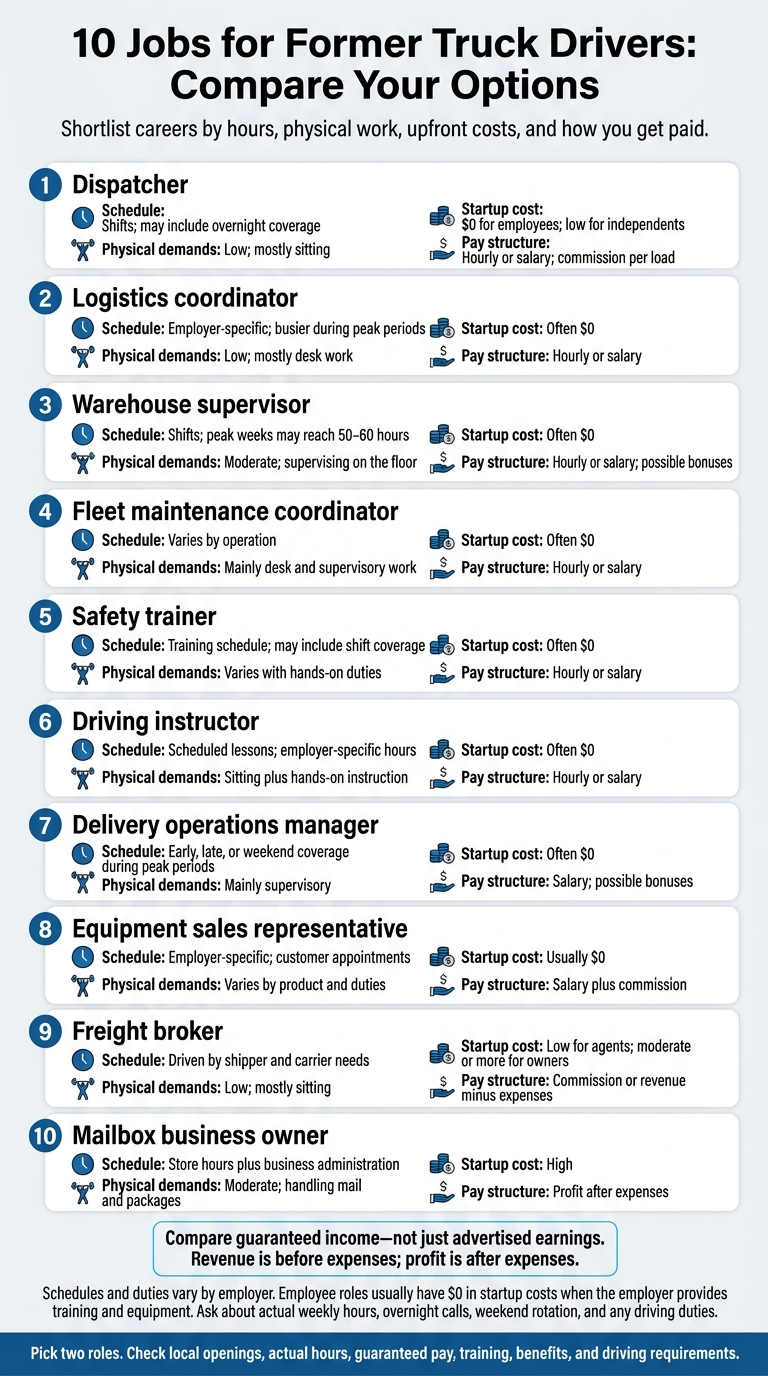
10 Jobs for Former Truck Drivers: Compare Your Options
What Your Trucking Experience Can Offer Beyond Driving
Your trucking experience gives you skills that apply beyond the driver’s seat. Route planning and shipment timing translate directly to logistics and dispatch work. Customer communication also fits dispatching and freight brokerage, where fast, clear updates matter. You’ll see those skills reflected in the jobs below.
Freight handling, inspections, and safe operations prepare you for warehouse supervision, safety training, and fleet maintenance coordination. If you’ve mentored new drivers, that experience can show your teaching ability. The next step is matching your strengths to roles with different pay, training, and schedule demands.
Start with your records: proofs of delivery (PODs), manifests, electronic logging device (ELD) logs, and safety records. Use them to document on-time performance, safety, and training results that show reliability for office, operations, or training roles. Include the timeframe and your role, and claim only improvements your evidence supports. Handling breakdowns, schedule changes, and volume spikes also shows you can solve problems under pressure - a useful skill in operations management.
Employee roles usually require little startup cash; ownership does not. Employers may provide paid training. Running a business requires customers, compliance, and enough working capital to pay bills before revenue comes in. Startup costs and compliance rules vary by business type. Weigh those differences against your pay, schedule, and startup-cost goals.
sbb-itb-f24084b
How to Read Pay, Training, and Lifestyle Expectations
Use these figures to compare dispatcher, logistics, operations, and ownership paths. Pay figures are benchmarks, not promises. Earnings depend on location, experience, employer size, responsibilities, and how pay is structured.
The BLS figures below reflect May 2024 U.S. wages. BLS data lags by a few months, so newer releases may update these numbers. Compare roles with similar duties rather than using these figures to predict your exact offer.
| BLS occupation or industry group | Reference period and geography | Median annual wage | Upper-end benchmark |
|---|---|---|---|
| Transportation, Storage, and Distribution Managers | May 2024, United States | $102,010 | Top 10% earned more than $180,590 |
| Logisticians | May 2024, United States | $80,880 | Top 10% earned more than $132,110 |
The median is the midpoint - not a starting offer. The top 10% figure shows an upper-end benchmark, not a typical starting salary.
Transportation, storage, and distribution management provides only a rough comparison for warehouse supervisor and delivery operations manager roles. A logistics coordinator’s duties may also differ from those of a logistician.
Separate guaranteed pay from variable income. For hourly offers, ask about guaranteed hours and overtime eligibility. For salaried roles, confirm expected weekly hours and whether the advertised amount includes bonuses. For equipment sales or freight brokerage, ask for the commission formula and payment schedule.
Revenue is money coming in before expenses. Profit is what remains after expenses - and neither should be confused with a paycheck.
Before paying for training, ask employers when training begins, whether it’s paid, and when you’ll receive your first paycheck. Look beyond the job title: compare shifts, weekend coverage, on-call duties, physical work, and benefits.
1. Dispatcher
Dispatching lets you stay in freight without driving. You book loads instead of hauling them. Dispatchers negotiate rates, manage schedules, and cut deadhead miles. Your route knowledge and familiarity with hours-of-service rules help you set pickup and delivery times drivers can meet.
To get comfortable with the office side, learn dispatch and accounting software. Start by managing freight for one truck before taking on more loads.
The work is desk-based, but the hours can be long. Employee roles may require 50 to 60 hours a week during peak season, including nights and weekends. Independent dispatchers often work from home and typically charge about 5% of a truck’s gross revenue. They also pay for software, load-board subscriptions, office equipment, and business setup.
2. Logistics Coordinator
Logistics coordinators move freight between warehouses and third-party logistics (3PL) hubs, track inventory, and keep shipments on schedule. Your experience tracking shipments, handling delays, and communicating transfers directly to this role.
Some employers accept operations experience without a degree. Target 3PL firms, learn the basics of a Warehouse Management System (WMS), and use shipment counts or freight values to show the scope of your work on your resume.
The work is desk-based, with fewer physical demands than driving. Expect about 40 hours a week, increasing to 50–60 hours from October through December. Busy hubs may also require nights and weekends. If you’d prefer more on-site oversight, warehouse supervision is the next step up.
3. Warehouse Supervisor
Manage the warehouse, not just the freight. Your trucking experience carries over through freight movement, loading and unloading, inventory checks, and cargo security. But instead of managing your route, you’ll manage people, inventory, and dock flow. That means assigning staff, planning shifts, checking inventory accuracy, and enforcing OSHA safety standards. Leadership and a visible presence on the floor matter just as much as freight knowledge.
Some employers accept proven operations and leadership experience instead of a degree. On your resume, spell out the teams, equipment, and shift coverage you’ve handled. Show that you can lead a team - not just move freight - and explain how you’d cover staffing gaps while staying involved on the floor.
Transportation, storage, and distribution managers earned a median of $102,010 in May 2024. That figure isn’t specific to warehouse supervisors, whose pay varies by employer, shift, and overtime.
Expect more walking and standing than in office-based roles, plus nights, weekends, and holiday shifts. Before accepting an offer, ask how much time you’ll spend on the floor and whether you’ll handle yard movements or trailer spotting. For a more technical path, the next role shifts to fleet maintenance coordination.
4. Fleet Maintenance Coordinator
Maintenance coordination offers an operations role with less people management. The goal: keep trucks road-ready and freight moving. You’ll track preventive maintenance, schedule repairs, and work with shops. Your inspection experience can help you spot problems before they take trucks off the road.
You don’t always need mechanic credentials - the job focuses on coordination. Start by learning maintenance-tracking software and practicing preventive maintenance (PM) scheduling.
Pay increases with fleet size and responsibility. A role overseeing a five-truck fleet may pay around $60,000 a year.
Expect to work in offices and shops, with after-hours calls when equipment breaks down. Some employers require a current CDL so you can move trailers during breakdowns or outages. If you’d rather prevent problems than fix them, the next role is safety trainer.
5. Safety Trainer
Put your road experience to work teaching safer habits. You’ll train new hires on pre-trip inspections and hours-of-service (HOS) documentation, then review electronic logging device (ELD) records and dashcam footage. Firsthand driving experience helps you mentor drivers and explain why the rules matter. This role may suit you if you can teach procedures clearly and stay calm under pressure.
Start by applying for internal trainer or safety roles and reviewing FMCSA and OSHA rules. You’ll need to explain mistakes calmly, build drivers’ confidence, and keep clear training records.
Your schedule will depend on the employer. Facility-based jobs usually offer steadier shifts than over-the-road driving. Ask about ride-alongs, backup driving, and yard moves. Some hubs require an active CDL for emergency trailer moves, while smaller fleets may pair safety duties with equipment operation.
Check local openings first to gauge pay. For context, the May 2024 median pay for transportation, storage, and distribution managers was $102,010 - a figure for that management category, not specifically safety trainers.
6. Driving Instructor
If you enjoy safety training, driving instruction takes that experience into the classroom and the cab. Instead of internal compliance and coaching, you’ll provide structured lessons for new CDL students at a school or carrier program. Your safe-driving habits, cargo-handling skills, and judgment on the road put you in a good position to teach.
You’ll cover regulations, hours of service, and cargo handling, then coach students through pre-trip inspections, backing, securement, and road driving. It’s a good fit for drivers who want to work directly with new CDL students.
Before applying to an established school, check that you hold the right CDL class, have a current DOT medical certification, and maintain a clean driving record.
Compared with ownership or commission work, school jobs usually offer a simpler way to get started. You won’t need startup capital, and these jobs usually provide W-2 employment with clearer schedules. You may spend more nights at home than you would with OTR work, though teaching still takes patience and focus. A CDL can add $2 to $5 per hour over non-licensed roles, with actual pay depending on your location and employer.
7. Delivery Operations Manager
Delivery operations management offers more responsibility than dispatch while keeping you in freight operations. You’ll manage the delivery operation, not just one truck. That means overseeing driver performance, rebalancing routes, and improving on-time delivery. You already know what leads to missed stops, late arrivals, and deadhead miles. This role puts that knowledge to work between dispatch, logistics, and fleet leadership.
Start with route optimization software, delivery metrics, and driver scheduling, including stop sequencing and driver utilization. Show that experience on your resume instead of focusing only on miles driven.
Pay usually depends on the operation’s size. Larger networks tend to pay more, but the schedule often includes early starts, weekends, and on-call shifts. If you’d rather work directly with customers in a role tied to product sales, the next option moves from operations to equipment sales.
8. Equipment Sales Representative
Moving from operations to a customer-facing role lets you use firsthand trucking experience to sell trucks, trailers, or fleet equipment. Pay is often commission-based. Your schedule may include office or dealership work, travel to customer sites, and occasional weekends.
Daily tasks include selling, preparing quotes, and advising buyers. You'll match equipment to freight needs, explain specifications, and discuss financing or leasing.
Cost awareness, equipment knowledge, and trust with fleet buyers help you explain operating costs and reliability. You'll also compare purchase price, fuel use, maintenance, and resale value. For used equipment, recommend a third-party pre-purchase inspection.
On your resume, frame your trucking experience as asset management and customer relations, backed by your knowledge of common truck and trailer models. Start by calling local dealerships, dealers, and fleet suppliers about sales openings. If you'd rather focus on deal-making than inventory and sales lots, the next option is freight brokerage.
9. Freight Broker
Freight brokerage keeps you in freight without managing inventory - ideal if you’d rather make deals than sell equipment. Freight brokers connect shippers and carriers, negotiate rates, and keep loads moving. You’ll sell loads, match them with carriers, and manage margins. Your knowledge of routes, equipment limits, and dock delays can help you spot deadlines that won’t work.
Starting as an agent for an established brokerage can let you work remotely without the startup risk of running your own business. Learn load boards, carrier vetting, and brokerage software before reaching out to shippers. Ask brokerages about their training, commission terms, and sales expectations.
Agent roles are mostly desk-based and usually require little upfront cash. Running an independent brokerage means higher setup and compliance costs. In either role, shipment problems may need attention after hours.
Use logisticians’ pay as a rough benchmark, not a firm income estimate. Broker earnings usually depend on commissions, shipment volume, and client mix.
If you want more control - and more risk - the last option is mailbox business ownership.
10. Mailbox Business Owner
Running a mailbox and package store gives you a customer-facing path to business ownership. Your trucking experience can help with package tracking, secure handling, and customer communication.
You’ll receive, sort, and securely store mail and packages, serve customers at the counter, and manage incoming and outgoing shipments. You’ll also handle missing, late, or damaged packages. Log every package and confirm pickups so each handoff has a clear record.
Before opening, budget for business registration, bookkeeping, communications tools, and local permits. Factor in recurring rent, wages, supplies, and fees, too. Your take-home earnings are what’s left after expenses, and they may be small while you build a customer base. Ownership gives you more control - but also more overhead and responsibility.
Compare the 10 Career Paths at a Glance
Compare these careers by budget, schedule, and physical demands to narrow your options. Employee roles usually have $0 in startup costs when the employer provides training and equipment.
| Career path | Main setting / travel | Typical schedule | Physical demands | Common entry preparation | Work status | Startup cost | Pay structure |
|---|---|---|---|---|---|---|---|
| Dispatcher | Office or home / usually no travel | Shifts; may include overnight coverage | Low; mostly sitting | Communication skills; dispatch experience | Employee or independent | $0 for employees; low for independents | Hourly or salary; commission per load |
| Logistics coordinator | Office or distribution center / travel varies | Employer-specific; busier during peak periods | Low; mostly desk work | Logistics knowledge; certification can help | Usually employee | Often $0 | Hourly or salary |
| Warehouse supervisor | Distribution center / usually no travel | Shifts; peak weeks may reach 50–60 hours | Moderate; supervising on the floor | Leadership experience; warehouse management system knowledge | Usually employee | Often $0 | Hourly or salary; possible bonuses |
| Fleet maintenance coordinator | Office or maintenance facility / travel varies | Varies by operation | Mainly desk and supervisory work | Fleet experience; employer-specific training | Usually employee | Often $0 | Hourly or salary |
| Safety trainer | Fleet office and training sites / travel varies | Training schedule; may include shift coverage | Varies with hands-on duties | FMCSA and OSHA knowledge; clean motor vehicle record | Usually employee | Often $0 | Hourly or salary |
| Driving instructor | Classroom and training vehicles / local driving | Scheduled lessons; employer-specific hours | Sitting plus hands-on instruction | Relevant CDL; driving experience; current DOT medical card when required | Usually employee | Often $0 | Hourly or salary |
| Delivery operations manager | Office or distribution center / travel varies | Early, late, or weekend coverage during peak periods | Mainly supervisory | Operations and leadership experience; logistics training helps | Usually employee | Often $0 | Salary; possible bonuses |
| Equipment sales representative | Sales office and customer sites / travel depends on territory | Employer-specific; customer appointments | Varies by product and duties | Equipment knowledge; employer-specific sales training | Usually employee | Usually $0 | Salary plus commission |
| Freight broker | Office or remote / travel varies | Driven by shipper and carrier needs | Low; mostly sitting | Agent: brokerage training; owner: broker authority, surety bond, insurance | Independent agent or brokerage owner | Low for agents; moderate or more for owners | Commission or revenue minus expenses |
| Mailbox business owner | Customer-facing store / mainly on-site | Store hours plus business administration | Moderate; handling mail and packages | Business registration; local permits; operating budget | Business owner | High | Profit after expenses |
Schedules and duties vary by employer. Ask about overnight calls, weekend rotation, and actual weekly hours. Treat compensation figures as comparison points - not job offers. Check guaranteed pay, bonus or commission terms, overtime eligibility, and any expenses you'll cover. Use these tradeoffs to identify which path fits your priorities.
Choose Your First Move Based on What Matters Most
Use these filters to narrow your shortlist after comparing the roles side by side. For predictable hours, look for fixed shifts, home-daily work, and little on-call time. Ask how traffic and tight appointment windows affect when your day ends.
To stay close to trucks without driving, compare dispatch, logistics coordination, fleet maintenance coordination, and safety training. If you want to teach, safety trainer roles focus on coaching, while driving instructor roles involve behind-the-wheel teaching. Mentoring new drivers points toward instruction; managing processes points toward safety work.
If neither training path fits, consider options with more independence. Compare freight brokerage and mailbox ownership by looking at licensing, cash flow, and startup costs first. More control usually comes with more risk and more cash tied up upfront. Match the business model to your available capital and how you prefer to work. If protecting your savings comes first, pursue an employee role before starting a business.
Once you have two finalists, test both against your needs. List your transferable skills, set your schedule and minimum-income target, check licenses and startup costs, and update your résumé with measurable results. Talk to someone currently in each target job about emergencies, delays, and after-hours call-ins. Take one step on each path: submit an application, arrange a shadowing call, or build a startup budget.
FAQs
What jobs can I get if I lose my CDL?
Losing your CDL doesn’t mean leaving transportation behind. Your professional driving experience can still help you land a non-driving role in logistics or transportation, such as dispatcher, logistics coordinator, warehouse supervisor, fleet maintenance coordinator, safety trainer, or delivery operations manager.
Dispatching, for example, draws on your firsthand knowledge of the road and what drivers need. You can also put your industry expertise to work as an equipment sales representative, freight broker, or business owner.
How can I switch careers without a pay cut?
Focus on roles that put your trucking expertise to work, such as logistics management, dispatching, or safety training. On your resume, describe your team leadership, the size of the operations you handled, and financial results in terms employers understand.
Aim for W-2 management positions or specialized logistics roles with structured compensation, rather than entry-level jobs. Treat seasonal or contract management work as a chance to prove yourself and move into a permanent, high-paying role.
How do I show trucking skills on my résumé?
Describe your trucking experience in plain language, backed by measurable results: loads hauled, on-time delivery rates, or miles driven. Swap vague phrases for specific skills, such as inventory control, freight management, and team leadership.
Tailor each résumé to the job posting’s keywords. Use terms like WMS or throughput only if they match your experience. This makes your qualifications easier for hiring managers to scan and may improve your résumé’s ranking in applicant tracking systems.